
The State of Recruiting and Hiring in 2026

You need someone amazing to do a great job. That’s easy, right? There’s TONS of people out there who need work… good people too. You’re not blind. You’ve seen the layoffs. The marketplace is absolutely saturated with talent. Grabbing the right person for the job should be easy… right?
You need a job. The first month or two after the layoff you knew that it was just a matter of time. You’re one of the best in the world at what you do. Sure, not everybody’s looking for your expertise, but there’s plenty of companies that could make a lot of money leveraging your skills. By month 5, you’re much less sure.
…And it goes on like this.
Both employers and employees are unable to find a fit. Everyone wants to work and everyone needs talent, yet the two never seem to find each other. Unfilled roles and unfulfilled households is just the norm… and that’s bad for everyone.
At some point, this became hiring. A permanent state of being rather than a task that one can expect to be completed. Recruiting forever, never at full strength. Meanwhile the talent that could make a company truly great lives in the endless job hunt.
Hiring is fundamentally broken, and it’s not fixing itself.
High Tech Recruiting
As tech companies have become more influential and powerful, they’ve frequently leaned into innovations that apply directly to the process of work. Where we once had manufacturing or supply chain advancements, those tangible innovations have been outpaced by workflow and labor optimization. At the same time, more and more of the workforce has been driven into office-style jobs, with nearly 40% of the US workforce now classified as “Management and Professionals” by the “US Department of Labor”.
Increased professionalization leads to more digital processes, which leads to logistical challenges in which solutions can be engineered entirely with software. The tech stack the average office-oriented company uses grew massively over the past ten years. We’ve moved past sending memos or scheduling meetings. Now we’re Slacking the Zoom link where we’ll go over the Asana board about the new Zap automations.
Recruiting certainly hasn’t been immune to this new era of “worktech”. There used to be a standard procedure when you needed help… list the job on your site and on a job board or two. That was it. Sure recruiters, placement specialists, and headhunters existed, but they were pretty niche. In most cases, they worked to add a human touch to that job listing and to filter out noise among applicants.
Times have changed. Now every major organization and random startup employs high profile recruiters. If they don’t keep them on the payroll, they pay massive commissions to outside experts.
The job hunt has also evolved. I’m not what I’d consider old, but I’m old enough to remember actually browsing a newspaper to find a job. Now there’s LinkedIn, Ziprecruiter, Indeed, Monster, 20 thousand freelancing sites, and a metric ton of pay to play niche job search sites. An entire category of influencer has been born out of “how to job search”.
The tech has gotten powerful. It’s ready to serve you related jobs, rate how qualified you are, and explain exactly how to put yourself at that desk. But from the inside it all feels a bit like an infinitely complex maze. If job seekers are running around like mice, every year it feels harder to find the cheese.
So the tech has supercharged both sides of the equation. That should mean better job hunts and better recruiting, right?
No one from either side will tell you it’s gotten better.
According to the “Bureau of Labor Statistics”:
- There’s 7.6m professional-level jobs open in the US right now.
- There’s 7.3m professional-level job seekers in the US right now.
Will they find each other?
It’s a nightmare, and the possibility of happy endings gets more distant by the day.
So Much Noise
But job indexing, leveraging data, and one-click applications are a good thing… aren’t they? Don’t we want people to be able to easily apply for the jobs that they want so that hiring managers can easily see more and better candidates?
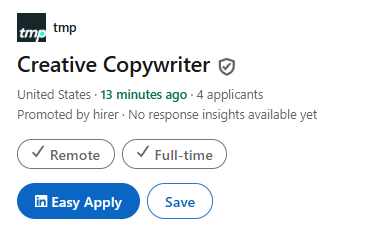
Job boards have grown a lot in recent years and feed you results in a way that feels a lot like social media. The easier it is to apply for a job, the more effective you feel like the site is. Scroll, click, endorphins. Scroll, click, endorphins. Every time a possibility that your brain can feel accomplished for creating. If you really need a job and you’re shown a job that’s even remotely close to something you can do, why would you not apply if you can apply in one click? Even if you don’t meet the qualifications, the cost of a 30 millisecond click is pretty damn low.
If it takes 20 minutes to apply, you make sure there’s a real chance you can get that job… but if it’s instant, why not? Enter the noise. Do you think you’d be the only one in the scroll, click, endorphin rhythm? The company paid to list that job there, and the site wants to give them results. Other people clicked those same jobs and it was just as easy for them. Maybe 100 other applicants, maybe over 1000.
But that’s not all… enter worktech. Want to put out 1893 resumes every day? Sure, there’s a service that will just blast your info at every single job it finds. Need some more refined applications? In a few hours of work you could have an AI agent that spits out applications with resumes customized based on the job description, and direct outreach to a hiring manager’s email address. More noise. What happens when a few thousands applicants are all doing that?
Let’s add an abstraction layer that exponentially increases the noise… recruiters.
Before we go further, I should disclaim. There are good recruiters out there. There are caring and qualified experts who actually look out for the welfare of their clients. There are many more who do not fit within that description.
Add the noise of thousands of social media personalities claiming to be experts on getting hired, all screaming their professional level of knowledge on how to create more noise within the system. Noise.
Many underqualified recruiters have self-appointed themselves to the role, and they loudly promote themselves and their abilities as the panacea that will save job seekers. It is quite common for them to take ~10% of a placement’s salary for the entire duration of their employment, so there is an incredibly high profit to placing people in high-paying roles. There’s no vetting, no regulation, no guarantee that these people are here to help. Add in the desperation of job seekers and scams, of course, abound. Noise.
High profit + low barrier to entry means that there is massive competition in this niche. So recruiters must be louder. They must promise more. They must make more noise to indicate that they are the ones who can get job seekers the best jobs. They are the ones who can find the best candidates for companies. THEY are the ones who deserve to make $10k/yr for 10 years because they happened to introduce Jack the frontend engineer to the CTO.
But the ability to make noise does not correlate to the ability to connect quality job seekers with employers. All both sides can do is hope that the recruiter is helpful, trustworthy, and experienced. NOISE.
Jump Through the Hoops!
So hiring is hard, right? Getting hired isn’t much easier. It’s harder to find good quality candidates, so companies find themselves squeezing that pipeline harder and harder year after year.
Positions that used to just be an interview or two and a quick reference check now require three interviews, 2 coding tests, a panel review, and flying across the country for an executive interview. That’s exhausting and stressful to individual job seekers, but it’s also time-consuming and expensive for the companies recruiting. The result? MORE process and requirements put into hiring to make sure that the candidate is up to snuff. And in turn, more stress and hardship for job seekers.
None of this is productive work. These multiple interviews aren’t getting projects accomplished for the employer and the potential employee isn’t getting paid for them. They’re just a waste of everyone’s time. The company may run through this sad routine dozens of times in one position. Meanwhile a job seeker may run through this same process dozens of times without successfully finding the job that they need to survive.
Then as a job seeker you start to get desperate. You start to get a little less critical of the hoops you’re being asked to jump through. Maybe you do a “sample project” or two to show off your skills, only to notice months later that the company used your work for profit after ghosting you. Maybe you chase a role for too long, not realizing that the job doesn’t actually exist. Instead, it was created to show shareholders that the company is actively hiring and busy (even when they’re not).
The process is dehumanizing for all involved… but companies aren’t humans. Job seekers pay the real price.
Judging People Is Hard
Attempts to entirely solve for the risk in hiring are pointless. There will always be some degree of faith involved in investing in a new employee.
People are complicated, and comparing the work and ability of multiple workers is not standardizable. People excel in roles because they’re complicated and they have unique abilities and thought processes. To think that you create a pipeline to measure future job performance is silly… There will always be personal judgement and instincts involved in the decision.

Even experts make wrong calls after extreme levels of diligence. If an organization is going to invest 100+ hours into the vetting, interviewing, and testing of a new employee, they still end up guessing just as much as a recruiter who spends just a few hours on it.
All the arbitrary requirements added on to the top of hiring don’t ensure better people. If anything, they filter out the most competent people. Making new hires jump through hoops ensures that you’ll get someone who will jump through the hoops you ask… but is that good? Do you want submissive, compliant employees? Or do you want independent thinking experts who value their own abilities?
Work Needs to Be Done
The most important thing about the absolute nightmare we find hiring in is simple… nothing gets done. While an organization is in an endless process of recruiting, vetting, interviewing, and negotiating without ever hiring, they are not moving forward. The entire point of hiring is because you need someone to do a job. Without a successful hiring process that reaches an eventual conclusion, there’s no one to do that job.
Meanwhile the individual that’s just trying to get a job isn’t moving their future forward. Their bills aren’t getting any easier. Their goals aren’t getting any closer. A good employee is adaptable, and if one doesn’t find what they need for long enough during a job hunt they will inevitably leave that pool of potential workers and find other pursuits that will enable them to thrive.
So if employers and employees both lose from recruiting, why is it still broken? Why do we tolerate a system that doesn’t seem to serve any of its participants in any way?
Hiring Sucks
Employers and employees aren’t the only participants in the hiring process. Job boards, social media, recruiters… there’s an entire industry built up around the idea of hiring. When a candidate successfully enters a role, there are less paying customers within this industry.
It’s important to note that this isn’t malicious. There’s no room full of evil executives out there drinking brandy and toasting the gridlock of 300,000 workers. The problem is simply a symptom of incentives. It is in the job board’s interest for you to look for a job. You finding a job gives them no additional benefit.
By not quite giving you what you wanted, they stand to make more. They leave you hungry, but give you enough of a taste that you’re sure the next course is worth it.
It’s the same for job seekers. They get the feeling of being able to apply for relevant jobs in one click, never realizing that this actively creates the kind of noise the job board’s business strategy was hoping for. Maybe those applicants are paying for a subscription for increased visibility. Think they’ll keep paying that if they get jobs? Even if they aren’t paying, they are content for the job board. Their presence brings appeal and prestige to the platform. The users are the product.
We could continue to discuss how hiring is broken ad nauseum, but the how doesn’t particularly matter. The commercialization of noise in the hiring process gatekeeps any potential change.
The global staffing and recruiting market yields over “$640bn in revenue annually”. The priority isn’t on placing candidates or finding the best job for a human individual. It’s on making that number higher.
Cherry Blossom: Roles Filled Instantly
At Cherry Blossom Tech we’ve seen the pitfalls of the recruiting industry, and we’ve deliberately designed our process to offer a better way.
Recruiting a group of quality developers takes time. Onboarding, training, and team building take even longer. You don’t just need to find one needle in the haystack, you need the dozen needles that are compatible to ship products with the other needles that you already found in the stack. Tall order.
Frankly we’ve never bought into that whole idea. We don’t use recruiters. We rely on direct referrals and personal networking. We hire fast and test people under working conditions, supervised by a team that is comfortable working together and getting new members up to speed. Our interviews are a filter, but we know that you really learn about someone when they’re settled in and working. We give our people time and flexibility so that they can have every chance to be successful.
We are constantly building and cultivating world-class developer teams, and we have teams ready to go at any time. They’ve worked together, they’ve built functional software, and they’ve launched them and made them work right under high customer demand. Your next dev team isn’t months of recruiting away… they’re already right here.
Hiring shouldn’t be an ongoing process. When you need people to do a job, you need experts you can count on right away. Contact us today so your new team can start building.